
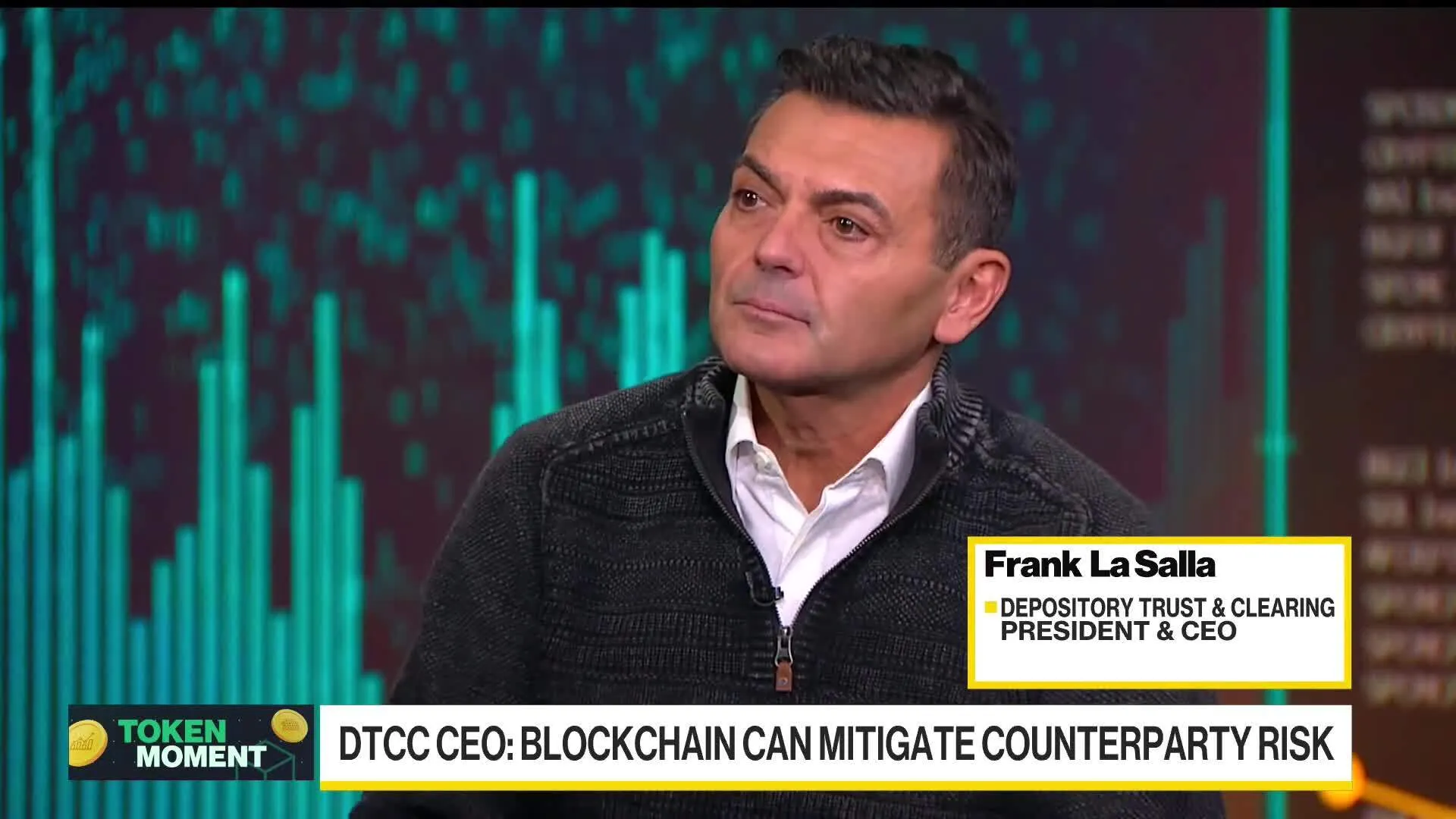
On 15 July, the Depository Trust and Clearing Corporation, the institution that settles almost every stock and bond trade in the United States, processed its first live production trades in tokenized securities. JPMorgan converted the Invesco QQQ Trust into a tokenized asset to open the day. Goldman Sachs, BlackRock, Vanguard and the New York Stock Exchange were among the participants, with a broader launch scheduled for October.
Now hold that against a second scene. A family in Ohio is nineteen months into settling an estate. There is a house, a quarter share of inherited farmland in Kentucky, an inherited IRA, a stake in a private company a friend incorporated in 2011, a condo in Florida that has triggered a second probate proceeding in a second state, and a hardware wallet in a desk drawer that nobody in the family can open. The will was clear. The intent was clear. Nineteen months later, ownership is not.
Those two scenes are the same story. Cerulli Associates projects that $124 trillion will transfer through 2048, with $105 trillion flowing to heirs and $18 trillion to charity. Around $54 trillion moves sideways between spouses first, including close to $40 trillion to widowed women, before it reaches a younger generation.

Source: Advisor Research Collaborative
The industry has spent three years selling tokenization as a liquidity story. Fractional ownership, round-the-clock markets, collateral mobility. Every one of those is a trading argument. I think we have been describing the wrong feature. The defining property of a token is not that it can be traded. It is that it can be transferred. And the largest transfer event in American history is already underway, running on county courthouses and registered post.
The paperwork crisis nobody declared
America has solved this problem once already, and then stopped halfway. In 1968, physical share certificates and manual back office processing overwhelmed Wall Street so completely that the New York Stock Exchange closed on Wednesdays for months while firms cleared a backlog of failed deliveries. The response was structural. The industry built the Depository Trust Company in 1973 to immobilise certificates and replace physical delivery with book entry transfer.
So America dematerialised ownership so that strangers could trade in days rather than weeks. It never dematerialised the one transfer that happens once in a lifetime and matters more than any trade a person will ever place. Probate is the paperwork crisis nobody declared, and it has been running quietly for sixty years. What DTCC did in July was finish the 1973 job. Nobody has started the other one.
The Succession Spread
I want to give this gap a name, because naming it makes it measurable. Call it the Succession Spread: the distance between the time it takes to settle an asset and the time it takes to settle the estate that holds it.
Settlement time | Cost | |
|---|---|---|
Tokenized money market fund | Seconds | Basis points |
US listed equity, T+1 | One business day | Basis points |
The estate holding both | 9 to 20 months | 4 to 7 percent of estate value |
Now run the arithmetic. Take the conservative end of that cost range and assume only a third of the $124 trillion passes through full administration rather than trusts, joint titling or beneficiary designations. That is roughly $1.6 trillion of pure administrative friction, extracted from American families over twenty-five years, before a single dollar of tax is paid. Treat it as an order of magnitude rather than a forecast. It is still the largest fee pool in finance that nobody markets against.
America's fifty-state problem
The friction is worse in the United States than almost anywhere, because probate is administered state by state with no national register. A second home in a second state triggers ancillary probate, an entirely separate proceeding in that state's courts. Timelines, thresholds and creditor windows all vary.

Source: Settled Estate
Layered on top is a planning gap that has not moved in years. The Trust and Will 2026 Estate Planning Report, a survey of 5,000 US adults, found 56 percent have none of the five core estate planning documents. Gen X is the least protected at 62 percent, even as 73 percent of Americans say estate planning matters to them.

Source: trust&will
The result is measurable. State treasurers hold roughly $70 billion in unclaimed property belonging to an estimated one in seven Americans, according to the National Association of Unclaimed Property Administrators. That is a national archive of transfers that failed.
The indivisible asset problem
Fractionalisation stops being a trading feature and becomes a family one the moment an asset cannot be divided. Three siblings inherit one farm. The only clean way to divide it today is to sell it, so forced sale becomes the hidden tax on inheritance.
America has a documented, severe version of this. Property passed by intestate succession becomes a tenancy in common known as heirs' property, where co-heirs hold undivided fractional interests in land that is never physically divided. The US Forest Service describes the consequence plainly: owners are private property holders but cannot build wealth from the asset, because creditors will not accept it as collateral. Any outside party can buy a single fractional interest and file a partition action to force a sale. The Federal Reserve Bank of Atlanta has documented the scale of the resulting land loss, concentrated among Black landowners in the South.
Tokenized fractional ownership with pre-emption rights, buyout mechanics, and voting thresholds written into the contract is not a novelty product for this problem. It is the missing legal plumbing for millions of acres.

Source: Lincoln Institute of Land Policy
Not every asset moves at the same speed
An estate is not one asset class, and tokenization does not arrive everywhere at once. McKinsey's framing is that adoption comes in waves, with cash, bonds, funds and securitisations moving first, while equities, real estate and precious metals lag on compliance grounds. Map that onto a typical American estate, and you can see exactly where the next twenty-five years go.
Asset | Weight in a typical estate | Tokenization status |
|---|---|---|
Cash and money market funds | Small | Live at scale |
Treasuries and bonds | Moderate | Largest tokenized category |
Listed equities and ETFs | Large | Entering production via DTCC |
Private company shares | Concentrated | Possible now, rare in practice |
Real property | Largest | Blocked at the county recorder |
Retirement accounts | Large | Custodian bound, unaddressed |
Life insurance and annuities | Moderate | Barely explored |
Collectibles and personal property | Small | Novelty stage |
The surprise sitting in that table is housing. The largest single tokenized real-world asset today is not a BlackRock fund. It is Figure's home equity line of credit token, at roughly $20.1 billion on RWA.xyz. Housing is the biggest asset in most American estates, and the debt written against it is already further on chain than the equity inside it.
America already wrote the law
Here is the part almost nobody in wealth management has connected. Two American legal frameworks already do most of the work, and neither was written with inheritance in mind.
UCC Article 12. The 2022 amendments created the controllable electronic record, a new category of personal property with rules for transfer of control and for taking free of competing claims. As the American Bar Association notes, the amendments extend the take-free principle to holders of these records. More than thirty states plus the District of Columbia have enacted them, and New York's version took effect on 3 June 2026.
RUFADAA. The Revised Uniform Fiduciary Access to Digital Assets Act, adopted in nearly every state, gives executors and trustees a legal route to a decedent's digital property.
The SECURE Act ten-year rule. Most non-spouse beneficiaries must now empty an inherited IRA within ten years of the owner's death, with annual distributions required from 2025 under the final IRS regulations. That is a programmable distribution schedule sitting in the largest pool of American household wealth outside housing, executed today by spreadsheets and reminder emails.
Parts of the legal foundation already exist. The remaining work is connecting commercial-law control, fiduciary access, probate authority, tax reporting and authoritative asset registers
What blockchain-native succession looks like
Bequeathable tokens. ERC-7878 proposes a standard interface allowing an owner to establish a will on-chain, designate executors, and build in a moratorium period before inheritance completes. The moratorium is the sophisticated part. It deliberately reintroduces delay, because delay is what protects against a compromised executor key.
Family quorums instead of safe deposit boxes. Multi-signature control across a spouse, an adult child, and an attorney removes the single point of failure in both directions. It stops any one person acting alone, and it stops an estate dying with one forgotten passphrase.
A death oracle America can actually build. Automated succession needs a trustworthy death signal. The Social Security Administration's Death Master File and state vital records already exist. Issued as a verifiable credential rather than a flat file, that becomes the input a contract can consume. This is infrastructure, not research.
Programmable bequests. Vesting to heirs over years, conditional distributions, automated charitable splits. A discretionary trust becomes a function rather than a fee.
The vault is a governance product, not a storage product. The interesting question about a family vault is not where the keys live. It is who has to agree before anything moves. A two-of-three quorum across a surviving spouse, an adult child, and the family attorney means no single person can act alone, and no single failure locks everyone out. Add a time lock and the design starts to behave like an estate actually behaves: a key that only becomes usable after a defined period of inactivity, giving the family a window to object before anything is distributed.
None of this is theoretical. Qualified custodians such as BitGo already run institutional-grade multi-signature key management, and self-custody providers including Casa, Nunchuk and Bitkey ship inheritance protocols with designated recovery contacts. What none of them offer yet is the thing a wealth manager would actually need: a single vault holding tokenized funds, tokenized equities and property tokens side by side, under one quorum, inside a legal wrapper a probate court will recognise.
That gap is the product. A safe deposit box holds objects and needs a bank to open it. A family vault holds claims and needs a family to agree. The bank was never the point. The quorum was.
The uncomfortable part for the wealth industry
The transfer rail is already built, and not by two firms. Custodians and clearers, including DTCC, State Street, BNY and Northern Trust. Exchanges including Nasdaq and NYSE. Issuance platforms including Securitize, which listed on the NYSE and tokenized its own stock on day one, alongside Ondo and Superstate. Banks including JPMorgan and Goldman Sachs. Asset managers including Fidelity, Invesco, Apollo, Hamilton Lane, WisdomTree, Franklin Templeton and BlackRock, whose chief executive devoted much of his 2026 annual letter to the same thesis. Franklin Templeton's BENJI opened peer-to-peer transfers to retail holders in 2025 and grew investor numbers more than 140 percent between April 2024 and March 2026.
The world is waking up to tokenization.
— Ondo Finance (@Ondo) April 13, 2026
Sandy Kaul, Head of Innovation at @FTDA_US, outlines what's driving it:
→ RWA tokenization has grown 5x since 2023, forecasts reach $4-16T by 2030
→ Tokenized stocks are the next wave, with Ondo Global Markets helping drive it
→… https://t.co/xnk7Oyqgax
The succession primitive is shipped. It is being marketed as a yield product.
There is a sting in it, and it points at the distribution layer rather than the manufacturers. Cerulli research reported by CNBC found that only 27 percent of future beneficiaries plan to keep their benefactor's advisor, falling to 20 percent among those who have already inherited. Tokenization does not stop heirs leaving. It removes the eighteen-month window during which a wirehouse, an RIA, or a bank trust department used to be able to persuade them. Retention has to be earned before the transfer now, not negotiated after it.

Source: CNBC/Cerulli Associates
What breaks
The strongest objection is not technical, and it deserves stating properly. Estate friction is legal and procedural rather than infrastructural. Probate courts, the IRS, elective share rules and will contests set the pace, and a faster ledger does not make a surrogate's court faster. A token representing a house is only as good as the county recorder willing to honour it.
That objection is right about the legal layer and wrong about the rest. Tokenization does not remove judicial oversight. It removes the reconciliation layer beneath it, which is where most of those months actually go. Writing to institutions, chasing valuations, discovering assets nobody knew existed. On-chain, an estate is enumerable by construction.
Three risks deserve honesty. Code cannot accommodate a court setting aside a will, so any serious design needs moratoria and judicial override. Coercion of an elderly key holder is an attack surface a bank counter did not have. And synthetic media makes proof of death oracles worth attacking.
Worth naming who loses, too. Probate attorneys, transfer agents, and parts of the trust and estates bar earn their living inside this friction. Some of that work is real legal judgement and will survive. A great deal of it is reconciliation, and reconciliation is what ledgers do.
Three predictions
By 2028, a top ten US asset manager ships beneficiary designation as a native feature of a tokenized fund.
By 2030, at least one state recognises an on-chain register as definitive for a single asset class, most likely Delaware or Wyoming.
By 2032, a major US bank trust department markets a family multi-signature vault as a retail product.
What This Means for Builders
DTCC's October launch is the gating event. Once tokenized securities settle inside the same rails as conventional ones, the objection that this is a parallel crypto system disappears, and every downstream use case becomes buildable. Succession is on nobody's target list. It should be. Four things are unbuilt and buildable now:
The death oracle. Vital records and the Death Master File as verifiable credentials a contract can consume.
Family quorum custody with an interface a 78-year-old can use. The cryptography is solved. The product is not.
The tax layer. Basis step-up, state inheritance tax, and the ten-year IRA schedule computed at the point of transfer rather than a year later.
Governance for indivisible family assets. Pre-emption, buyout and valuation logic for the farm, the business, the second home.
At NestiFi we come at this from the other end, helping families build wealth together before any of it needs to move. The two problems turn out to be the same problem viewed from opposite ends of a life.
One question worth sitting with
If transfer becomes instant, cheap, and programmable, what is left of the argument that it should happen at death at all? The current model delivers capital to heirs in their fifties, when they need it least, in a single lump, at the worst possible emotional moment. Programmable rails make continuous transfer possible. Small, regular, deliberate. The Great Wealth Transfer does not have to be an event. It could be a stream.
I wrote about the human side of this in an earlier piece on the Great Wealth Transfer, and about the institutions rebuilding settlement in Wall Street on the Blockchain. This is where those two threads meet.
If you found this analysis valuable, subscribe to Synaptic Finance and connect with me on LinkedIn for weekly deep dives at the intersection of AI, blockchain, and the future of finance.
