

A credit union can have strong reserves, loyal members and a viable loan book, yet struggle to deliver the services those members now expect. Merging may solve that problem. It also transfers decisions that will be difficult to recover.
That is why Todd Proulx's The Integrated Credit Union Core, published by the Swoboda Research Centre, matters. It offers a way to acquire capability collectively while retaining local institutions.
My view is that this could change the merger conversation. But sharing a platform only protects independence if credit unions retain meaningful control over it. Todd's architecture is the starting point for that argument.
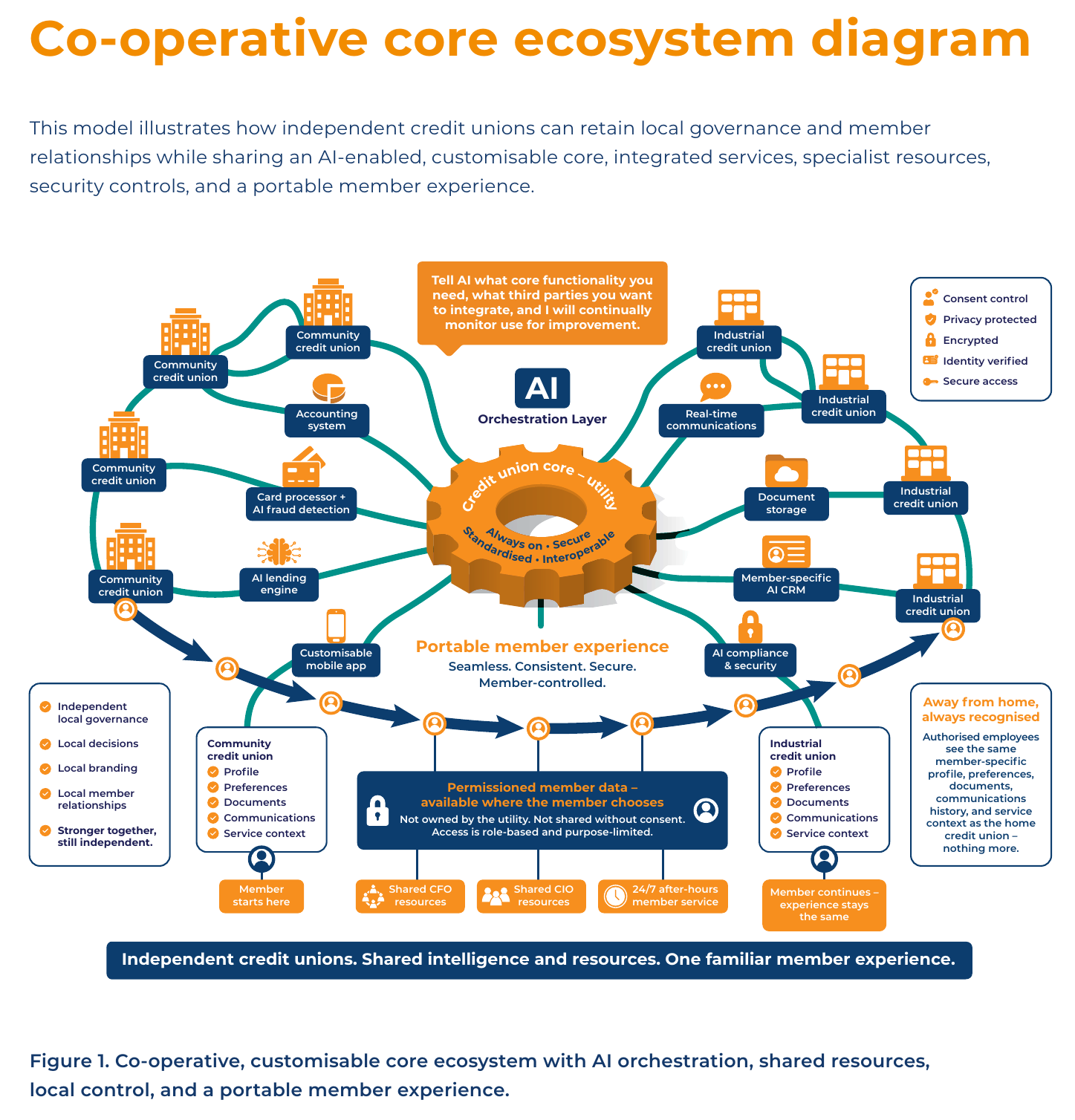
Source: Todd Proulx, The Integrated Credit Union Core, Swoboda Research Centre, Figure 1, page 13. View the original diagram.
The architecture changes the question
The diagram connects independent credit unions to a shared core covering accounting, payments, lending, compliance, member relationships, and digital services. Shared specialist resources sit alongside it. Local governance and member relationships remain with each institution.
This is a proposed operating model, not evidence that every component has been deployed. Its significance is the separation of two things often bundled together: the scale needed to run infrastructure and the scale needed to serve a community.
A local lending decision may benefit from knowing the borrower. Maintaining separate document storage, security tooling, and supplier contracts rarely benefits from that same local knowledge. The case for sharing depends on identifying which activities gain value from difference and which merely accumulate cost through duplication.
There is a limit. If every institution insists on bespoke workflows, exceptions and reporting, the common platform can become an expensive collection of individual systems. Independence therefore requires an agreement about what participants will standardise. Keeping every operational habit is not the same as preserving a distinctive member proposition.
A capability problem needs more than one solution
CUCollaborate's Q1 2026 analysis reports that 22 of 27 US merger approvals cited expanded services; two cited poor financial condition. These are self-reported reasons from continuing credit unions, not proof that technology caused each merger.

Graphic: Synaptic Finance. Source: CUCollaborate analysis of Q1 2026 NCUA approvals. Self-reported reasons, not evidence of causation. View source.
Nevertheless, the distinction changes what boards should compare. A merger proposal promising better digital services should be assessed against a credible shared-service alternative, including transition costs and delivery time. Comparing a well-developed merger plan with an undefined promise to collaborate makes the outcome almost predetermined.
Distress, succession problems and weak economics can still make a merger the right answer. A shared core cannot manufacture a management team or create demand for an uncompetitive product. My argument is narrower: institutions should not surrender their independence simply because nobody has costed another route to capability.
CUCollaborate: The Quarterly Download, merger trends. Watch the discussion.
Who owns the decisions?
This is where I would push Todd's proposal hardest. A credit union can retain its name and board while losing practical control over pricing, product development, and access to its own information.
The governance arrangements matter as much as the software. Who sets priorities when a large participant wants mortgage functionality and smaller institutions need basic servicing improvements? Who funds the work? Can members of the utility choose another provider for a particular service?
There is an established reference point. CU*Answers describes itself as a credit union-owned technology co-operative, and its ownership guidance gives owners one vote in board elections. That demonstrates an ownership mechanism, not proof that its products suit every institution.

Source: Swoboda Research Centre, executive briefing, page 2. Original extract. Read the briefing.
My preference would be for transparent investment decisions, protection for smaller participants and an enforceable right to leave with usable data. Those terms need to cover extraction costs, transition support, and the continued availability of essential services during a move.
The ability to leave has value even when nobody intends to exercise it. It gives a dissatisfied institution bargaining power. Without it, a shared utility risks becoming another supplier that is too difficult to replace.
Scale has to fund the next upgrade
There is an economic tension here. Participants want lower costs today, while a platform needs continuing investment to remain useful tomorrow. A co-operative can underinvest just as a commercial supplier can overcharge. Ownership aligns some incentives; it does not eliminate difficult budget decisions.
I would want a visible annual maintenance budget, a funded multiyear development plan and agreement about who pays for capabilities that initially benefit only a few institutions. Otherwise, the largest participants may subsidise everyone until they leave, or the smallest may pay for features they never use.
The promising part is reuse. Once a new service has been integrated, the next participating credit union should be able to adopt it with less work. If each adoption still requires a lengthy bespoke project, the supposed scale advantage is not reaching the customer.
That makes the cost and time of the second, fifth and tenth implementation a revealing measure. The utility should become better at adding capability as participation grows, without closing the door to outside innovators.
Measure the work that disappears
Todd's distinction between connected products and an integrated environment is useful. I would take it one step further: integration should be judged by work removed from the institution and friction removed from the member's day.
Ron Shevlin's 2026 Cornerstone Advisors study, based on 416 senior bank and credit union executives, identifies continuing gaps between technology plans and execution. A bigger budget does not resolve the shortage of people able to implement change.
Consider a member who starts a loan application online, then calls the branch. If staff still request documents already supplied, reconcile conflicting records, and chase another supplier, the institution has bought connectivity without resolving the operational problem.
I would compare application completion, staff handling time, repeat contacts, and error correction before and after implementation. Count migration, training, and parallel running in the cost. Savings that appear only after excluding the hardest parts of the transition are not a sound business case.
There is also a growth question. What will the credit union do with the time released? A plan to redeploy capacity into member conversations and lending is more persuasive than assuming efficiency will automatically produce stronger relationships.
A common platform can spread the cost of security expertise and recovery arrangements. It can also make a single outage affect several institutions simultaneously. Those are two sides of the same design choice.
The Central Bank's April 2026 remarks on operational resilience are relevant here: boards retain ultimate responsibility for IT risk. Irish credit unions are expected to address IT review gaps by early 2027, ahead of DORA applying from January 2028.
I would ask providers to demonstrate recovery when a shared service fails, including how staff communicate with members and continue essential operations. A larger supplier is not automatically a resilient supplier. Nor does co-operative ownership remove the need to challenge its management.
The AI layer deserves the same treatment. Todd's diagram includes AI lending, fraud detection and orchestration. Before judging the promised intelligence, test whether access is restricted, actions are traceable, and a person can intervene. Automating a poor decision across a shared platform could multiply its consequences. Begin with bounded tasks whose errors can be detected and corrected.
Member portability also needs precision. I would expect a member to understand which institution can see which information and why. Joining a shared platform should not make unrelated institutions interchangeable custodians of someone's financial life. Convenient service and narrowly controlled access should be designed together.
Ireland's opportunity is to use its strength
The Irish context is more encouraging than a story of institutions being forced together by weakness. The Central Bank's report published in April 2026 records €22.5bn in assets, €7.7bn in loans and average realised reserves of 16.8% for the year ended September 2025.

Graphic: Synaptic Finance. Source: Central Bank of Ireland, financial year ended September 2025, published April 2026. Read the report.
Sector averages do not establish the health of every credit union. They do suggest an opportunity to make infrastructure choices while resources are available, rather than waiting for operational strain to narrow the options.
The question is how much of that collective financial strength can become collective operating capability. Money on a balance sheet does not by itself produce mortgage servicing expertise, a usable app or a reliable integration.
Nor should Ireland simply import the US model. Governance, regulation, institutional size and member needs differ. Todd's architecture is useful as a set of choices to test locally, with specific services and accountable participants, rather than a ready-made national implementation plan.
Start smaller than the ambition
Filene's Small Credit Union Collaboration research examines seven cases involving shared knowledge, services and people. It provides a useful reminder that collaboration does not have to begin with replacing the ledger.
I would start with one painful member journey or shared operational service. Choose participants with compatible needs, name the person accountable for delivery and agree the measures before buying technology. A successful first project should establish whether the institutions can make decisions together, not just whether their systems connect.
My board checklist would have four questions:
What improves for members? Specify the service, completion time, or access that changes.
What stops being duplicated? Identify the work, contracts, and costs that actually disappear.
Who decides when interests diverge? Agree voting, funding and dispute arrangements before the first disagreement.
What happens if this disappoints? Test recovery, replacement and exit alongside the attractive demonstration.
Then expand only when the operating evidence supports it. This approach gives the sector a way to learn without making every institution dependent on a single enormous conversion programme.
However, a pilot needs a destination. Repeatedly adding isolated services could reproduce the fragmentation Todd identifies. Each project should establish reusable data definitions and operating responsibilities, with a clear decision about when replacing the core becomes necessary.
It also creates a fairer comparison with merger proposals. Boards can compare demonstrated shared capability with the concrete benefits of consolidation, rather than choosing between an executable transaction and an attractive diagram.
Why I care about this
At NestiFi, we build family wealth and financial literacy services above the core. Our distribution partnership with Vyrdia covers more than 30 credit unions with $6.5bn in combined assets. The easier it becomes to integrate responsibly, the easier it becomes for businesses like ours to serve the sector.
My broader conviction is that credit unions should be able to add useful services without each integration becoming a separate institutional project. Shared infrastructure could make that possible. It should also keep the market open to competing providers.
Read the proposal, then challenge it
Swoboda's free executive briefing introduces the model; Todd's full paper develops it. His 2020 podcast on core IT and the conference discussion below provide additional context.
Swoboda technology panel, 24 May 2024. Archive recording. Watch on YouTube.
Todd's principle, “Automate the transaction. Invest in the relationship,” captures the opportunity. My addition would be to make the governance, implementation and exit arrangements strong enough to protect that relationship when commercial interests diverge.
Created with AI assistance for research, drafting, and visuals, under my editorial direction. I take responsibility for the final content.
Credit unions should have a credible choice about how they acquire capability. The integrated core earns its place in that choice if it delivers better services, preserves meaningful control, and makes independence affordable. Keeping a charter is only the beginning. Keeping the ability to decide what members need is the real prize.
