
I would build through this political cycle. I would be much more careful about what I assumed would survive it.
That is my reading of the opening now facing crypto, stablecoins, and agentic finance. With the CLARITY Act stalled, the practical decisions are moving to the SEC, CFTC, and banking regulators. For a founder, the question is whether the permission you use today can become a business that still works when a different administration takes over.
There are roughly 26 months until January 20, 2029. That is a planning horizon, not a legal guarantee. Courts can intervene sooner. Agencies can change their minds. And a late rule can be easier for the next Congress to overturn than an early one.
The opportunity is to use temporary political room to build something expensive to unwind: compliant operations, customers who rely on the service, and a record that supports the rule behind it.
Stop waiting for Congress to settle it
A Democratic Congress taking office in January changes the industry's priorities. The next two years are likely to bring more scrutiny of crypto firms, while agencies remain the most immediate route to new operating permissions.
The legislative route has narrowed sharply. CLARITY failed cloture 49 to 50 on September 15. AP reported that ethics objections helped block the bill, despite some Democrats remaining open to negotiations. Cynthia Lummis is still arguing the case. Her post captures how far apart the two sides remain.
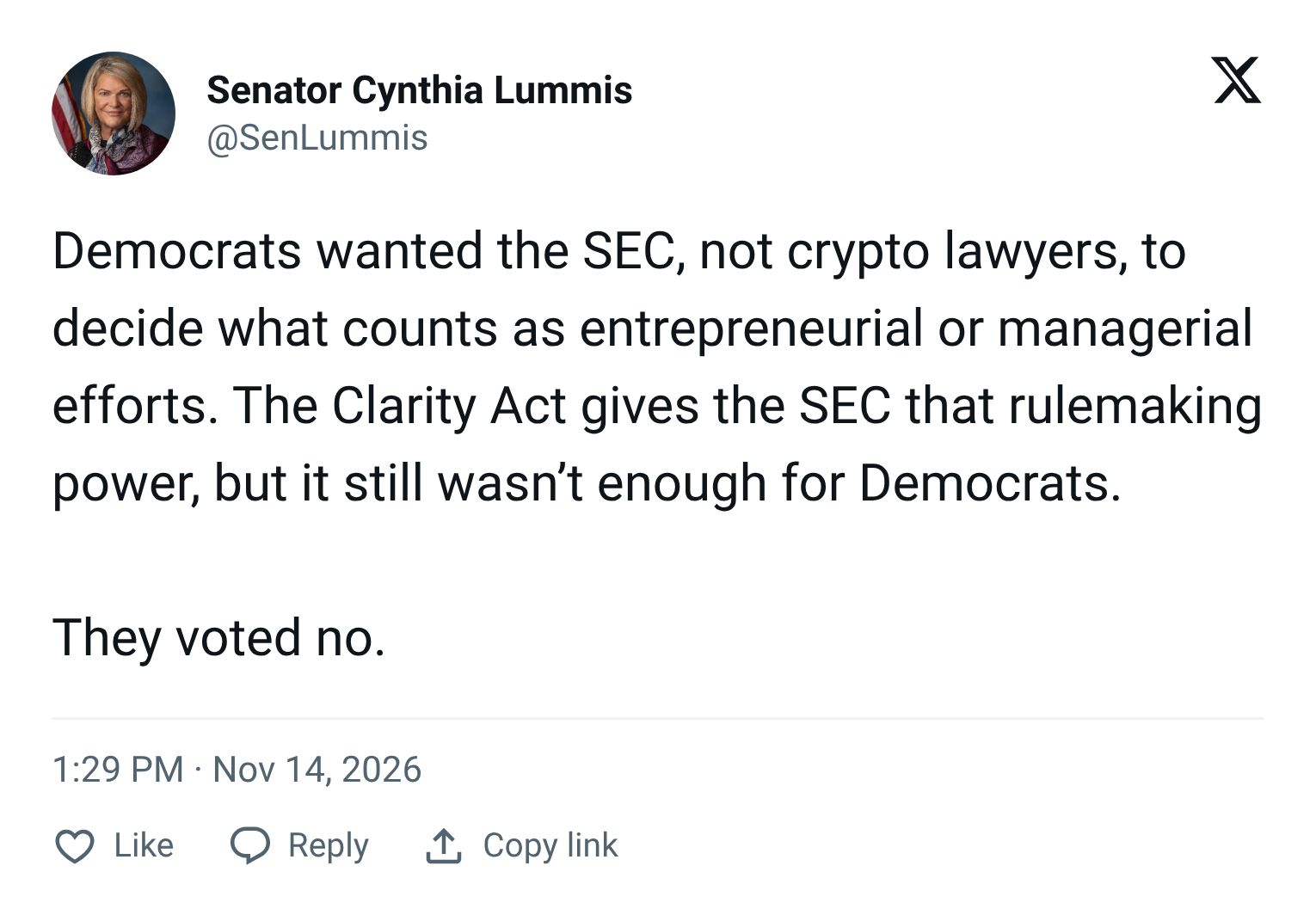
A major bipartisan deal remains possible. I would not make a product roadmap depend on one. The near-term work is with the agencies: identify the decision your business needs, put operational evidence into the record, and show how the proposed safeguards would work in practice. That requires a different kind of engagement from lobbying for a bill.
The veto buys time, not certainty
The CFTC chair’s September response to the stalled bill shows the agency's route in his own words. I read it as a statement of intent; the rulemaking record and the courts still determine what survives.
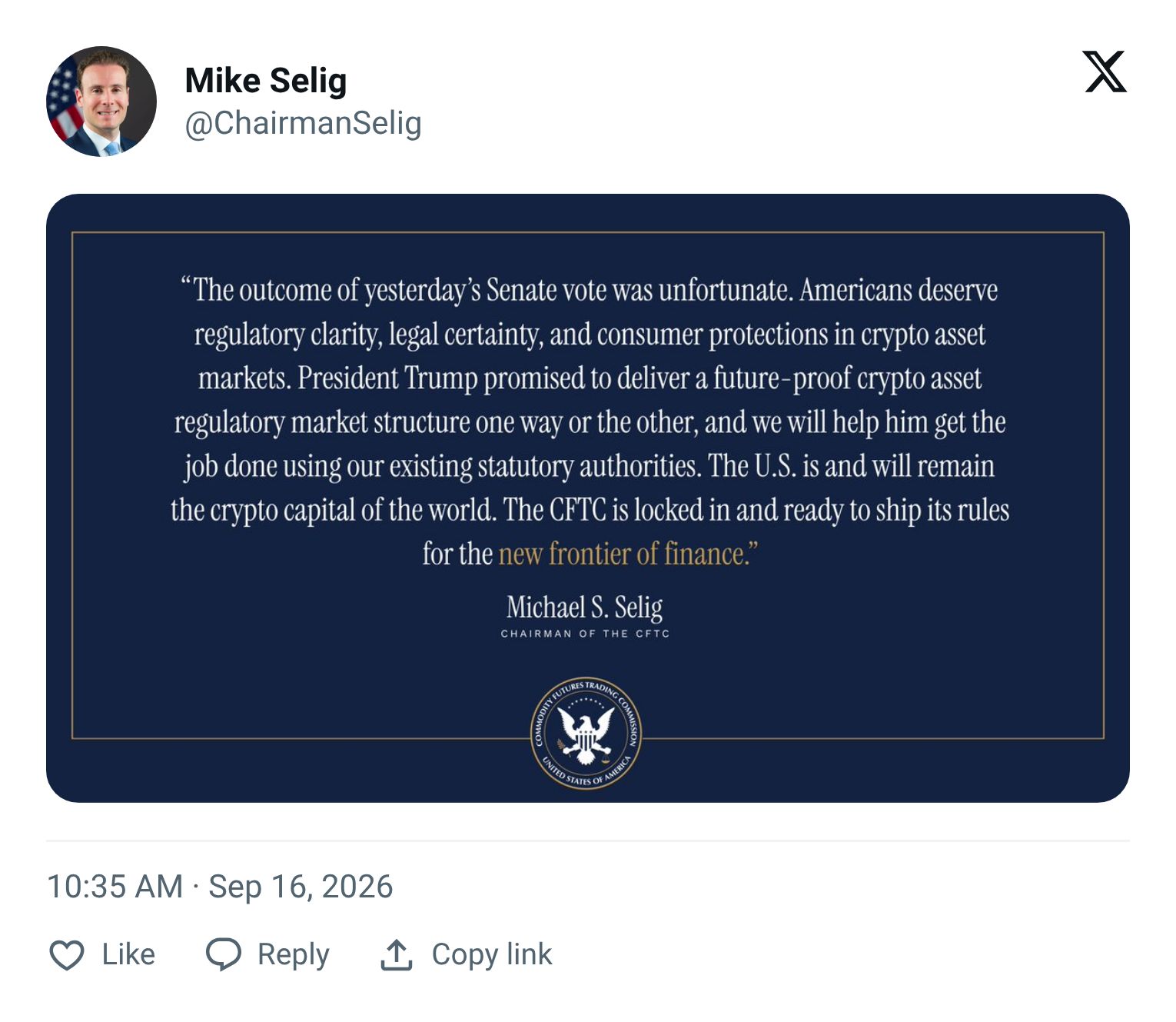
The Congressional Review Act gives Congress a route to overturn agency rules. But a disapproval resolution still needs the president’s signature or a veto override. That makes a hostile Congress less powerful than the election headlines suggest. Hearings can make life difficult, and litigation remains a separate route. Reversal through the CRA requires a political coalition capable of turning a resolution into law.
Which agency actions count as rules under the CRA? The CRS decision tree is a useful reminder that the analysis goes beyond the label an agency puts on a document.

Original CRS decision tree, Figure 1, p. 4. Source: Congressional Research Service.
Crypto has seen the reverse case. In April 2025, a Republican Congress and president used the same law to overturn the IRS DeFi broker rule. The tool that protects crypto can then be turned on in 2029 if both chambers and the White House line up against it.
The agencies are also getting staffed up. On November 12, the White House sent four nominations to the Senate: Nathan Anonick and Matthew Rowland for the CFTC, and Steven Levine and Kristin Johnson for the SEC. Nominations are not confirmations. For a company waiting on a decision, staffing and the commission’s ability to act belong on the operating calendar alongside the rule itself.
Courts are the other risk, and they do not wait for 2029. In Loper Bright, the Supreme Court ended Chevron deference: judges must exercise independent judgment over statutory meaning. Any crypto rule resting on a contested reading of “security” or “swap” can face that scrutiny. A friendly regulator cannot promise a friendly court.
The deadline I would put on the board agenda
This part of the timeline gets missed. The Review Act has a lookback provision: rules submitted late in a congressional session can receive a fresh review period in the next one. The calculation uses Senate session days and House legislative days, not ordinary calendar days. Recesses matter. A rule issued months before a presidential transition can still fall inside the window.
2028 is an election year with long recesses. Rules sent to Congress from roughly mid-2028 onward could be reviewed in 2029 by a new Congress and a new president. A rule struck down that way cannot be reissued in substantially the same form without new legislation. For planning, I would work backwards from summer 2028. The exact cutoff depends on the congressional calendar, so 20 months is an estimate. The commercial implication is concrete: a company that helps improve a proposal now has a better chance of operating under a settled rule before that risk increases.
Not every permission is equally durable. The first question is what legal instrument the business actually relies on. The SEC offers a useful example: in January 2025, staff rescinded SAB 121 with SAB 122. A company relying on a staff interpretation should not value that permission as though Congress had written it into statute. I would want that distinction made explicit in every investment memo.
Stablecoins: build on the statute, not the interpretation
Stablecoins offer the clearest example of why the legal foundation matters. GENIUS gives the sector a statute to build on. The OCC has finalised its implementation rule, effective January 18, 2027. That is a more substantial foundation than a favourable speech or an informal assurance. The commercial task is to turn it into an operating model that can withstand scrutiny.
Be careful about which parts you rely on. The OCC’s transition waiver process allows eligible issuers with a substantially complete application pending by January 18 to request more time. A waiver is a request, not an automatic entitlement. I would put the application, reserve arrangements, redemption process, and compliance ownership on one board-level plan. Regulatory timing becomes commercially useful only when the business can meet the conditions.
The adoption I find more useful to watch is operational. PNC now lets corporate clients receive stablecoin payments. Visa and Lloyds have also piloted stablecoin settlement. These are treasury and settlement workflows with an identifiable customer. My preference would be to build around those recurring needs, with reserves, redemption, and compliance designed to withstand a less friendly supervisor.
There is also a new customer for payments infrastructure: software. Stripe and Tempo’s Machine Payments Protocol lets agents pay for services through a common payment flow. The useful test is whether that produces repeat revenue from real tasks. An announcement alone does not establish demand.
The BIS chart below separates stablecoin usage from the assets backing it. I would want evidence of repeat payment demand before assuming that growth in token supply translates into a durable payments business.
Stablecoin usage and reserves

Original BIS chart, Annual Economic Report 2026, Chapter III, Graph 1, p. 87. Usage estimates: 2024. Reserves: March or April 2026. Source: BIS.
Markets and prediction markets: the most exposed ground
Tokenized markets show why the terms of permission matter. The SEC’s five-year innovation exemption is conditional. It requires safeguards, including equivalent ownership rights, publicly auditable smart contracts, and alignment with trading halts in the underlying stock. Those conditions shape the product. They should be part of the architecture from the start.
The BIS’s proposed architecture is a useful reference point. The diagram puts governance beside the assets and money. That is how I would assess a tokenization business too: who can participate, who settles the payment and who is accountable for the system?

Original BIS diagram, Annual Economic Report 2026, Graph 9, p. 107. A proposed architecture, not a live platform. Source: BIS.
The CFTC is at an earlier stage with CTX and CAM. Its advance notice of proposed rulemaking asks for input on a framework; it is not a finished operating regime. I would keep a live distinction between what is authorised, what has been proposed, and what is still being discussed.
DTCC offers a different signal. Its planned connection to Solana in the second half of 2027 concerns eligible DTC-custodied assets, with existing investor protections and ownership rights retained. The interesting question is whether tokenization can fit into the infrastructure that institutions already depend on.
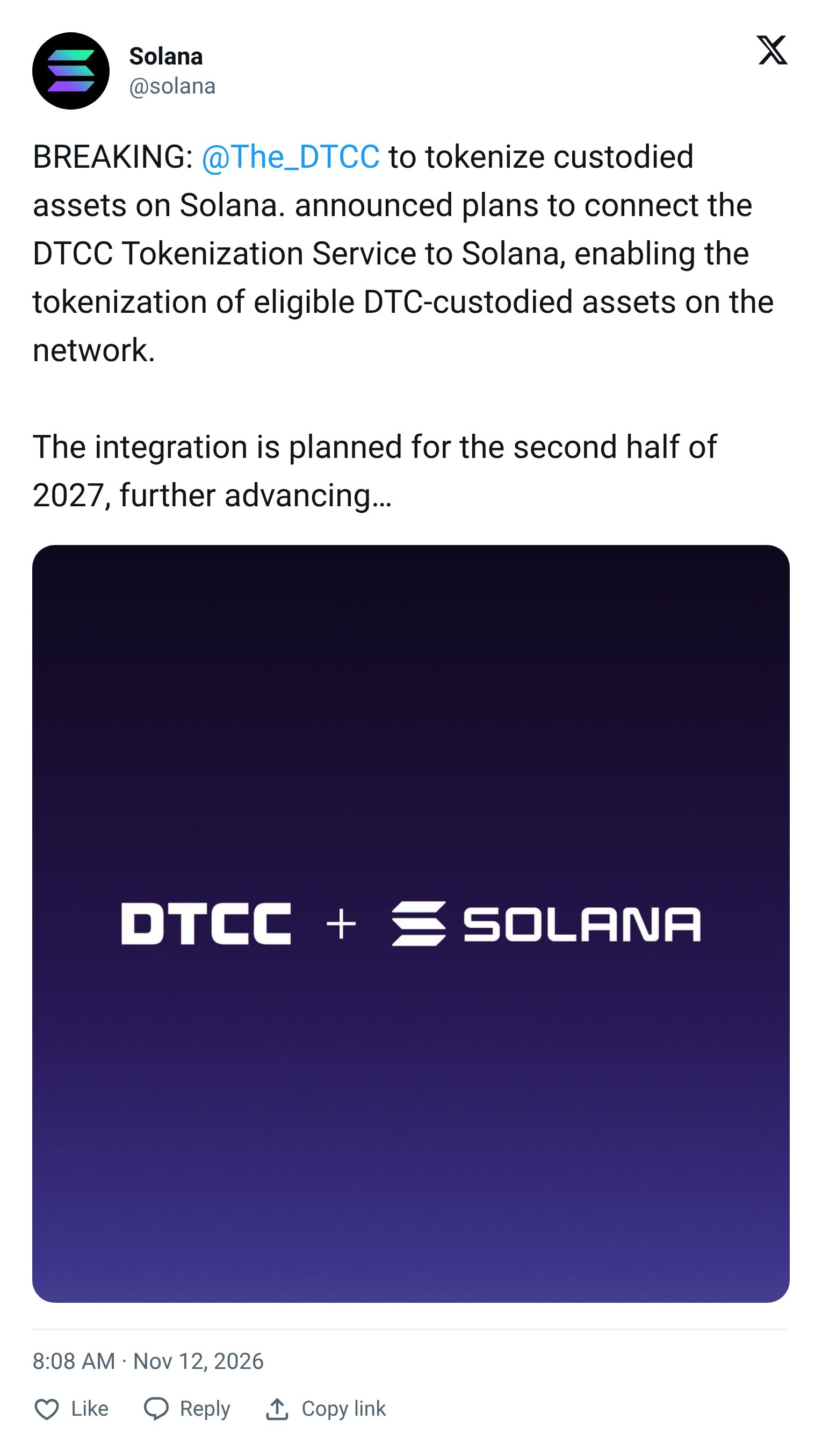
Solana’s announcement of the planned DTCC connection. The 2027 timetable is a plan, not a completed launch.
Prediction markets remain particularly exposed. On November 13 the CFTC sued Louisiana after a state court order against more than 30 firms. Louisiana’s attorney general disputes the federal position, as her statement below makes clear. Comments on the CFTC’s proposal addressing event contracts within the swap definition close November 18. Kalshi’s Supreme Court filing is due December 7. These are live disputes, not settled permissions.
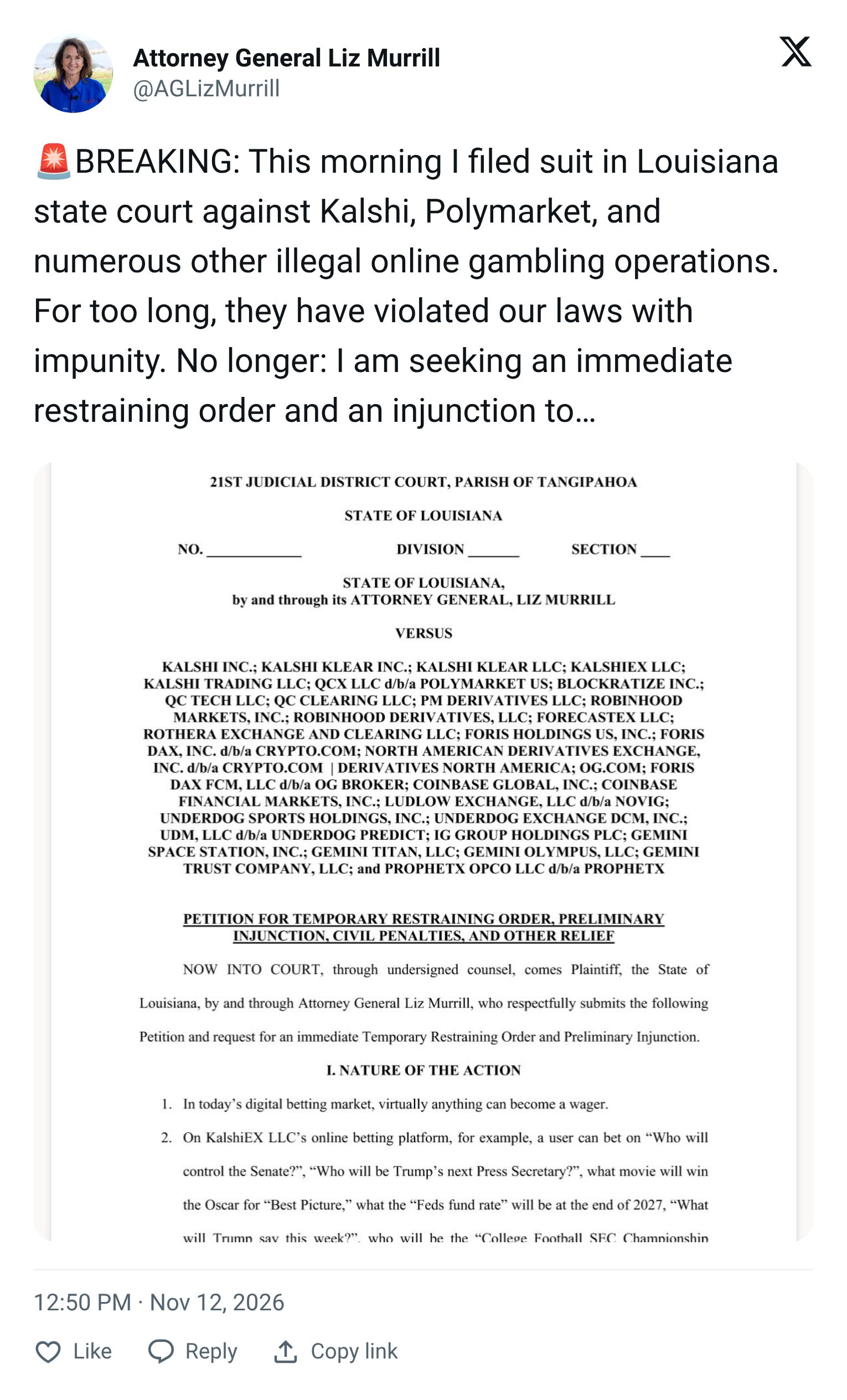
Operators still depend on the commission’s interpretation of the statute, a proposed rule, and the outcome of litigation. Finalising the swap rule well before mid-2028 would give them a firmer basis to plan, although it could still face a court challenge. I would put resources into helping the CFTC finish that work, with evidence and safeguards strong enough to support the rule in court.
For agent payments, the audit trail is part of the product
Agentic finance is already becoming an operational question for banks. The OCC’s November examiner guidance on advanced AI uses a risk-based approach. It is an examiner resource, not a new set of enforceable requirements for banks. That distinction matters: it tells us how supervisors may examine the activity without pretending that every liability question has been settled.
Visa’s Trusted Agent Protocol addresses how merchants recognise legitimate agents and their intent. Its live pilot with BILL and Billtrust takes that into supplier payments. The demo below shows an agent paying an approved invoice through a supplier portal while preserving controls.
Visa demonstrates its live AI payments pilot with BILL and Billtrust, including the supplier-payment workflow and its controls.
NIST’s draft concept paper places the agent, its model and its tools inside a wider trust boundary. For me, that is the right starting point for accountability: examine the whole path from instruction to action, not just the agent’s name.

Original NIST NCCoE diagram, Figure 1, p. 5, February 2026 draft concept paper. This is a conceptual architecture, not a certification or binding requirement. Source: NIST.
My test is simple. Can the business show who authorised the agent, what it was allowed to spend, which action it took, and when access was revoked? Can a customer dispute the result without reconstructing a chain of model outputs? Those are product requirements I would fund now. An audit trail that a bank and its customer can both understand is more valuable than a claim that the agent is autonomous.
Stripe Developers’ walkthrough makes the implementation choices easier to see: how an agent pays, how spending controls work and where stablecoins fit alongside other payment methods.
The CFTC’s forum takes the discussion beyond payments. Once agents trade derivatives, exchanges and supervisors need to understand how those agents behave in a live market.
CFTC Frontier Forum, 28 October 2026. Full recording covering advanced AI in derivatives markets and agentic trading. Source: CFTC.
Read more: Know Your Agent Is the New KYC.
Power makes the same argument in physical form
Data centres expose the limit of treating regulatory permission as a permanent asset. A project needs power, permits, and a community willing to accept its costs. The demand for compute can keep growing while individual sites become much harder to finance.

Original PJM capacity-price map for the 2026/27 delivery year, extracted from its July 2025 auction release. The $329.17 figure is a wholesale capacity price per MW-day, not a household electricity tariff. Source: PJM, page 3.
PJM's own release puts the pressure in perspective: demand is rising as the supply balance tightens. Capacity costs are only one component of a retail bill. Treating an auction-price increase as an equivalent increase in household bills would miss the point. The political issue is who pays for the next increment of infrastructure.

Original demand-forecast chart from Houlihan Lokey's July 2025 PJM report, cropped from page 16 with its source note retained. These are historical forecast vintages, not a new forecast for November 2026. Read the report.
The IEA’s 2026 report on energy and AI makes the bottleneck visible. Its ERCOT chart shows both large-load and supply-side connection queues, with current peak demand as a reference. A queue is not a forecast of projects that will all be built. That is why I would ask which projects have secured power, rather than treating every announced megawatt as future capacity.

Original IEA chart, Key Questions on Energy and AI (2026), Figure 1.6, p. 26. Queue observations run from December 2024 to January 2026. Source: IEA, CC BY 4.0. Cropped from the report.
For me, the link to crypto is the cost of reversal. A permitted project with contracted power is in a different position from a presentation promising future capacity. I would want the financing model to show who bears connection delays, infrastructure costs, and changes to the operating assumptions. That distinction belongs in valuation, not just in the risk section of a deck.
What I would do with the next 20 months
If I were allocating capital across these businesses, I would want the team to answer five questions before asking for a larger budget.
What exactly permits this business to operate? Name the statute, final rule, exemption, or supervisory position. Then show what happens to revenue if that permission changes.
What can we help get finalised? A useful comment record, operational evidence, and workable consumer protections are contributions regulators can use. A press release about regulatory clarity is not.
Which decisions must happen before summer 2028? Treat the lookback as a scheduling risk. Put rulemaking dependencies next to engineering and commercial milestones.
What would make reversal costly? Document customer reliance, compliance investment, and measurable benefits. None of those prevents a policy change, but they give the next regulator something concrete to weigh.
Would the product still make sense under a tougher supervisor? If the economics require weak safeguards or an unusually generous interpretation, I would want that exposed now.
I am optimistic about what can be built in this period. Payments still need to settle, markets still need better infrastructure, and agents will need accountable ways to transact. Those needs will outlast the current commissioners.
What I would not pay for is a business that confuses today's welcome with permanent permission. Use the window to win customers, improve the rules, and prove the service deserves to remain. That is a much stronger position to take into January 2029.
If you found this analysis valuable, subscribe to Synaptic Finance and connect with me on LinkedIn for weekly deep dives at the intersection of AI, blockchain, and the future of finance.
